Digital first, AI second: the sequencing that unlocks smarter bank guarantee management
Trade finance remains one of the most operationally intensive areas of corporate treasury. Even in large and sophisticated organisations, the management of bank guarantees, letters of credit, surety bonds and other instruments still often depends on a patchwork of emails, local portals, spreadsheets and manual follow-up. As volumes increase across entities, geographies and financing partners, these fragmented processes can create inefficiencies, limited visibility, weaker controls and unnecessary operational risk.
This is precisely why trade finance digitalisation has become a strategic priority. The objective is not only to replace paper or manual steps, but to create a more connected, transparent and scalable operating model – one that allows corporates and financial institutions to work from the same reliable information, automate repetitive tasks, and manage workflows with greater consistency and control.
Against that backdrop, the conversation around AI is becoming more relevant. But its role should be understood in the right sequence: not as a shortcut around digitalisation, but as the next layer of value built on top of it.
That is where the real opportunity lies – combining a robust digital foundation with new capabilities that can further improve speed, control and client experience.
A strong digital foundation first
Komgo’s focus is on providing the digital infrastructure for trade finance that enables corporates and financial institutions to manage workflows more efficiently, connect through trusted communication channels and synchronise data across counterparties.
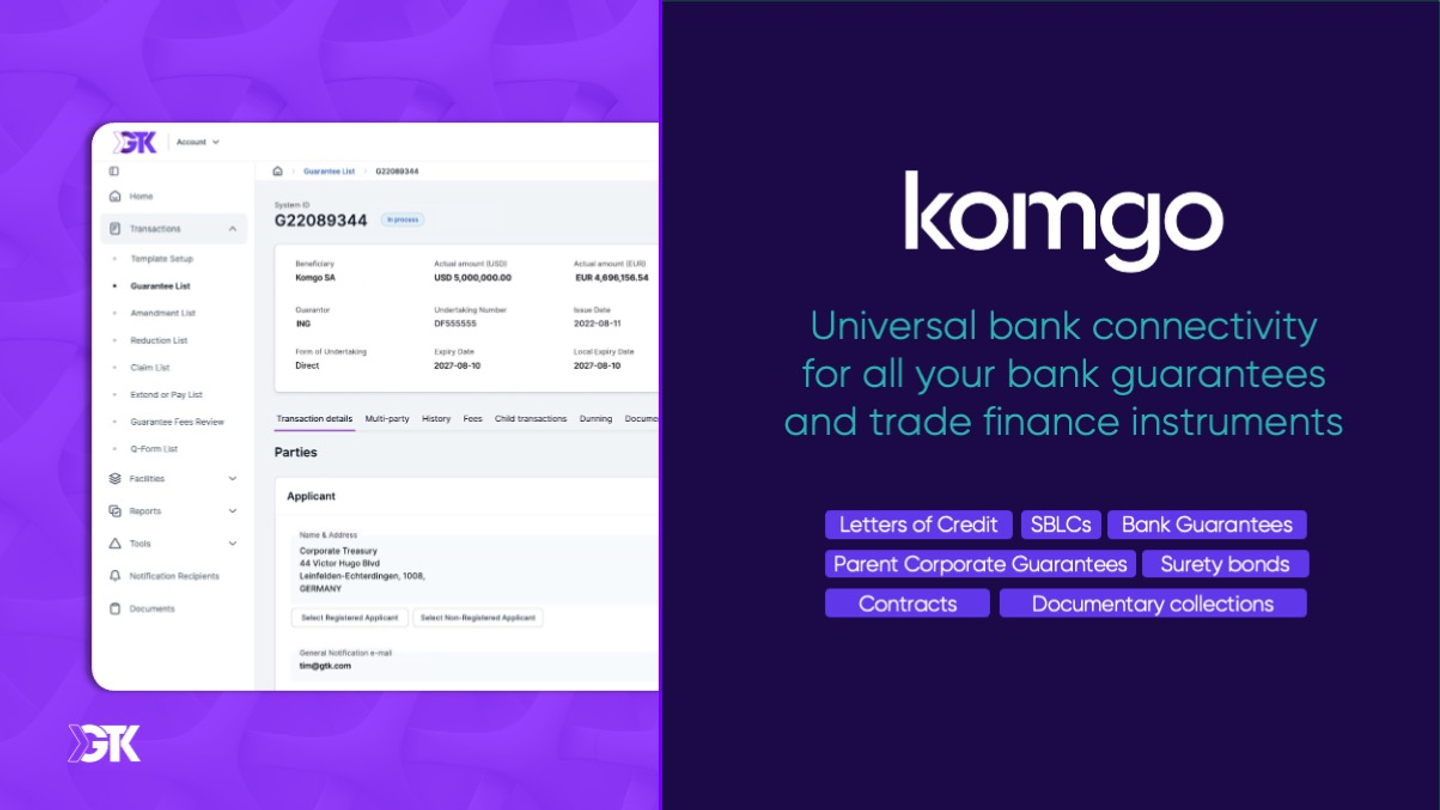
Solutions such as GTK (a bank guarantee and trade finance management platform) and Konsole (a trade finance communication and synchronisation hub) are a case in point. These tools help modernise how trade finance instruments are issued, tracked, amended and reported, while supporting the broader transformation of treasury operations.
With AI, in particular, Komgo’s view goes beyond it being a standalone innovation layer; it is the natural extension of a strong digital trade finance foundation.
For many treasury and trade finance teams, the first challenge remains operational: fragmented workflows, multiple communication channels with financial institutions, inconsistent data and too much manual follow-up across guarantees, letters of credit and other instruments. The answer, believes Komgo, is to address these fundamentals first – centralising workflows, synchronising data between counterparties and creating the trusted digital layer required to improve visibility, control and efficiency – while aligning with the ICC rules and Swift frameworks that underpin consistency, interoperability and trust across the ecosystem.
"It is fair to wonder whether AI is simply becoming a necessity in trade finance — or whether it has already become indispensable,” said Tim-Emilien Tran Ngoc, global head of business development at Komgo. “Our view at Komgo is that AI only creates real value when the digital foundation is already in place. On top of strong, connected and structured workflows, it becomes a powerful lever for efficiency, control and better decision-making."
AI where it counts: from days to minutes
The difference becomes concrete in day-to-day operations. Take guarantee text review – one of the most time-consuming steps in the issuance process. When a business unit requests a bank guarantee, the wording must be reviewed against internal policies and bank-acceptable language before it can move forward. For complex or non-standard guarantees, this back-and-forth can stretch across several days.
Today, Komgo's AI capability performs that first-pass analysis in minutes – flagging policy deviations, identifying problematic wording and surfacing the points that require human review. The expertise doesn't disappear; it is redirected where it matters most.
Beyond guaranteed text review, AI can help reduce manual effort across document and data review, support drafting, surface exceptions earlier and make operations more scalable and auditable – allowing teams to focus more on judgement, risk assessment and decision-making.
Extending value into existing ecosystems
The next step is not simply to add more AI features within one platform, but to ensure that digital trade finance workflows can connect naturally with the enterprise AI environments companies are already deploying across their organisations.
As treasury teams increasingly adopt these technologies, expectations are rising around how systems can be queried, connected and automated.
This makes API readiness increasingly important – not only to support interoperability across the trade finance ecosystem, but also to meet the new technical expectations created by enterprise AI environments.
For clients, the benefits are clear: a more connected operating model, faster access to information, less manual rekeying, more intelligent workflow support, stronger auditability and a digital infrastructure designed to evolve with the next generation of enterprise technology.
|
Meet Komgo at CT Week, Hong Kong This is exactly the type of discussion Komgo is bringing to CT Week. The team will be present and speaking about what ‘good’ looks like when digital trade finance foundations and AI come together. For treasury teams exploring how to modernise bank guarantee and trade finance management, it is an opportunity to see these capabilities firsthand and discuss how they apply to your organisation. |